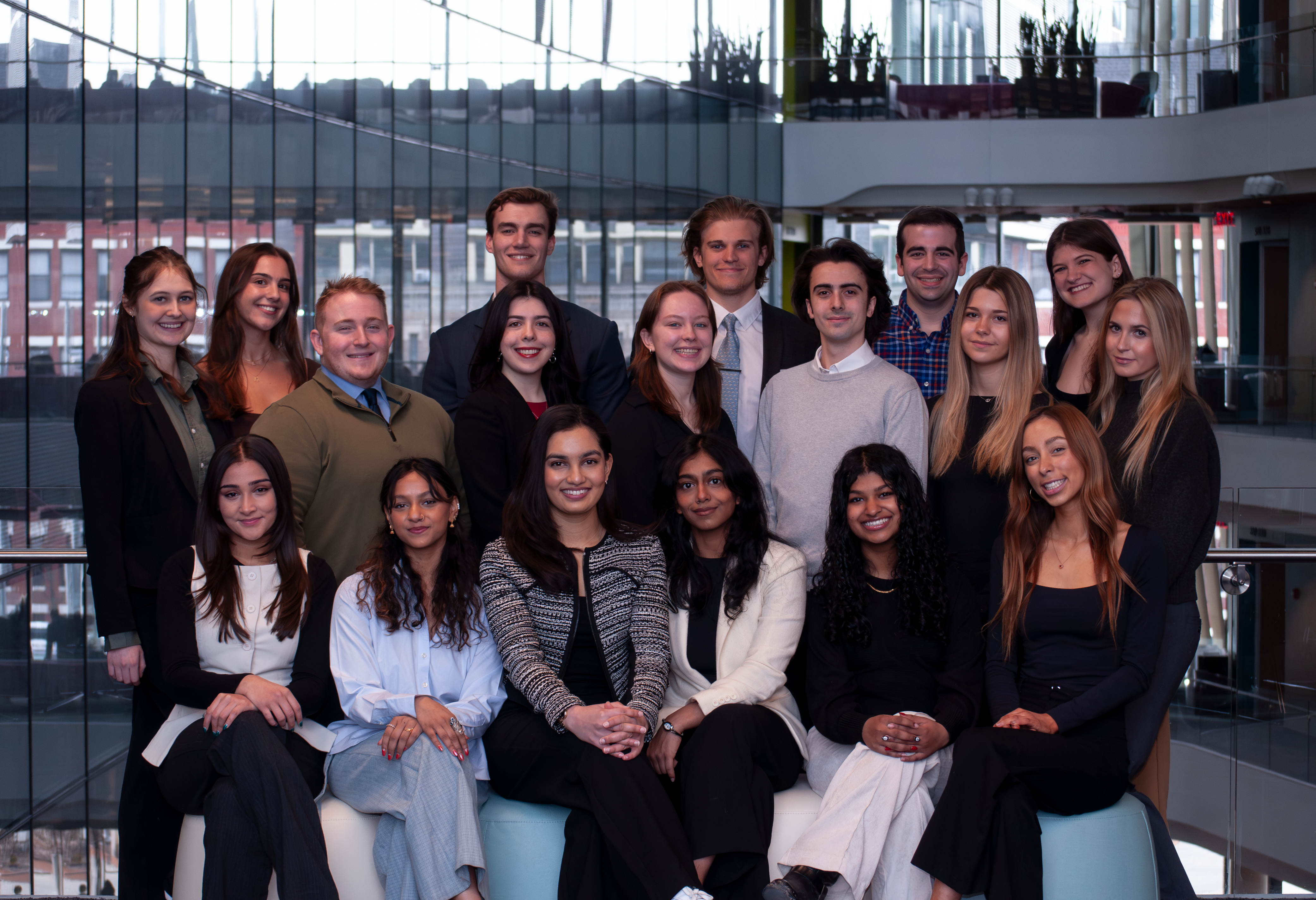


Founded in 2023, Northeastern University Undergraduate Law Review (NUULR) grants undergraduate students the opportunity to gain exposure to legal writing and research. Our organization combines the guidance of skilled editors with the passion of talented staff writers. Collaboration is at the heart of our editing and writing process, as each piece is reviewed and revised countless times prior to publication. Our Masthead oversees the daily functions of the organization, from formatting the publication at the end of each semester to booking our weekly meeting room. Our division of labor allows each member of the organization to focus primarily on their area of interest. Though we encourage our Print Writers to remain within the bounds of a theme, there is significant flexibility to remain within one’s area of interest. For instance, under the theme of constitutional law, writers were able to explore reproductive healthcare and assess the constitutionality of corporate monopolies – two fundamentally distinct areas of law. Since legal scholarship is significantly different from the type of literature undergraduate students are familiar with, NUULR fosters a community of exceptional undergraduate students eager to tackle advanced writing in preparation for law school and legal co-ops. This is how the NUULR community came to be.
Semester 1
Our first themed Print publication, focusing on artificial intelligence across legal lines, was an academically rigorous and complex collection. With topics ranging from workers’ rights to the legality of Deep Fakes, our writers covered a breadth of concepts intertwined with the law and artificial intelligence. During this semester, our writing and editing structure differed greatly from the system we now utilize. Two editors oversaw the entire writing process, editing countless digital and Print pieces. Our digital writers were known as “Mini Editors,” assisting the two lead editors in providing feedback to Print Writers. Thanks to NUULR’s inaugural semester, we realized that editing is a lengthy process that requires a larger team of editors.
Semester 2
The following semester, hoping to address some of the editing challenges from our first semester, we created more editing positions, with a total of four Research & Notes and Articles & Notes editors. Our Research & Notes editors specialized in revising footnotes and citations, while our Article & Notes groups employed a high-level approach to improving each piece’s organization and thematic relevance. We also divided our Print and Digital Writers among our editors, with each set of Research and Articles editors overseeing half of the staff writers. This system facilitated more personalized feedback, as each editor now had a smaller workload. Editors and writers began to develop strong relationships inside and outside of NUULR, as more time could be spent on each writer’s piece. Gaining momentum from the effectiveness of our new structure, we published an academically rigorous but engaging Print publication exploring constitutional law, focused on stare decisis, the separation of powers, and judicial review.
Semester 3
Building off the successes of the previous year, we maintained our writing system in the Spring 2025 semester, publishing a diverse collection on current issues in the law. During an especially tumultuous political and legal era, our writers worked tirelessly on pieces that challenged current legal frameworks on religion, critically assessed Section 203 of the Voting Rights Act, and questioned the federal and state balance of our immigration system. We also began making efforts to develop the social side of our organization, hoping to deepen our relationships with one another into a community of like-minded scholars. By planning various social events that would occur at the end of meetings, such as legal jeopardy and pizza nights, we transformed our writer-editor relationships into friendships. Our Thursday night meetings began feeling more like hang-outs and less like meetings.
Semester 4
In Fall 2025, we published Issue 4, which delved into the nuances of education law, a highly relevant sphere of law that gave our writers the freedom to explore a wide range of topics, from the relationship between athletics, education, and the law to a standardized medical education system. Our community began socializing with the law reviews of our neighboring universities, including Harvard, Boston College, and Tufts. As we continued to turn into an interconnected pre-law network in the Greater Boston area, we worked to further formalize some of our inter-organizational processes, such as developing a writing style guide and policy outline.
Semester 5
This semester we highlighted areas for reform in the law, taking a critical look at offshore private equity funds while also analyzing feminist movements in South Korea. In order to distinguish the work of Print writers from Digital, we developed a formal system by which each Print Edition will be published in the format of traditional law review notes, while the Digital Edition would be transformed into an interactive blog-style layout. We further streamlined our editing process by finalizing the editing protocol sheet and writing etiquette guide. Our NUULR community grew as our Digital Writer group increased in size and a younger generation of editors and writers joined our organization, passionate to share their fresh ideas and knowledge. Our social events increased in frequency and included brunches and game night parties. We planned an extravagant end-of-year celebration for our semesterly launch party to celebrate the hard-work and dedication of our Masthead, Editors, and Writers. As our club’s inner-workings became increasingly streamlined, each member’s connection to NUULR deepened, allowing this once disjointed but dedicated group to become a compartmentalized team.

As I prepare to graduate this Spring, I look back on my journey with NUULR with immense pride for the quality of the work we put forth. I reflect on the countless hours, meetings, and nights spent ensuring that each writer’s ideas come to life and the clear successes we have enjoyed. A special thank you to Preeta and Alex for making this final semester as part of Masthead extraordinarily memorable. I am so thankful our readers will engage with our work and learn something from it. I am so thankful to have achieved my goal of helping contribute to creating a close community of writers interested in the law at Northeastern.
About the Author
Anika Iyer is a senior in the Honors program at Northeastern majoring in Political Science and Human Services. Anika is the Executive Editor at NUULR, overseeing the writing process between editors and writers, developing materials to standardize guidelines, and ensuring the general functionality of the organization as a whole. She has been with NUULR since its founding, starting off as a Staff Writer, writing the piece “Plausible Alternatives to our Exclusionary ‘Winner-Takes-All’ System: Proportional Representation and Its Merits.” She then worked as an Article and Notes Editors for a few semesters before transitioning into her role as Managing Editor.
Anika’s legal interests primarily lie in public interest law, with a focus on public health issues. The Human Services aspect of her major has allowed her to develop a strong understanding of the issues faced by various marginalized groups and how this can impact health outcomes. She is interested in using the law to address some of these issues. She has completed two law firm co-ops at Choate, Hall & Stewart LLP as a Legal Recruiting Assistant and Ropes & Gray LLP as a Law Library Assistant. Anika also currently interns in the Medical-Legal Partnership Unit at Volunteer Lawyers Project and will work with the Advancing Harm Reduction Through the Law project during Summer 2026.
Outside of NUULR and work, Anika loves to sing, cook, go to the gym, and try new coffee shops and restaurants around Boston.
